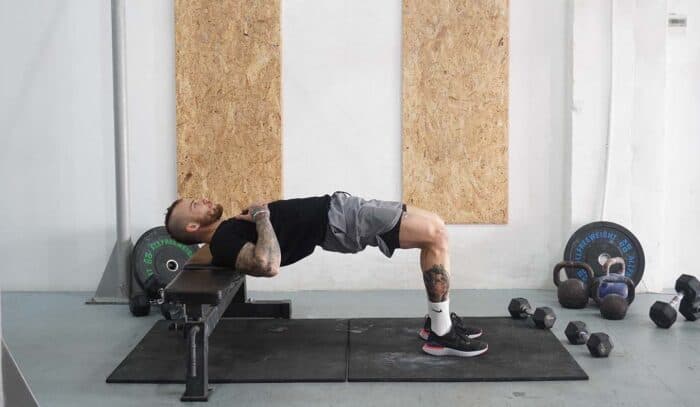
The KAS (Kas Glute Bridge, named after its popularizer Kassem Hanson) glute bridge is a specialized variation that maximizes time under tension at the top of the hip thrust movement — where glute activation is highest. Unlike a traditional hip thrust that uses the full range of motion, the KAS bridge uses a shorter range with a longer squeeze.
How to Perform the KAS Glute Bridge
Setup: Position yourself as you would for a standard barbell hip thrust — back on a bench, barbell across your hips, feet flat on the floor.
The movement: Start at the top (full hip extension). Lower only 2-3 inches, then drive back to full extension with a hard, 2-second glute squeeze. The range of motion is intentionally small.
Tempo: Lower slowly (2 seconds), pause at the bottom (1 second), drive up explosively, hold the squeeze (2 seconds). Each rep should take 5-6 seconds.
Sets and reps: 3-4 sets of 8-12 reps. The reduced range of motion allows heavier weights than full-range hip thrusts.
Why the KAS Bridge Works
Maximum glute activation zone: EMG research shows that glute activation peaks at full hip extension — the top of the movement. By restricting the range of motion to this peak zone, every portion of every rep occurs where the glutes are maximally engaged.
Reduced hamstring involvement: The shortened range of motion decreases the contribution of the hamstrings, isolating the glutes more effectively than a full-range hip thrust.
More weight, more tension: Because the range is shorter, you can typically use 10-20% more weight than a full hip thrust, further increasing the tension on your glutes at the top.
When to Use the KAS Bridge
Use it as your primary glute isolation exercise on lower body day, or as a finisher after squats and deadlifts. It pairs exceptionally well with full-range hip thrusts: do full-range first, then switch to KAS bridges to further fatigue the glutes at peak contraction.
KAS Bridge Programming on FitWit AI
FitWit AI can incorporate the KAS glute bridge into your lower body programming. It tracks your performance and progresses the weight systematically for maximum glute development.